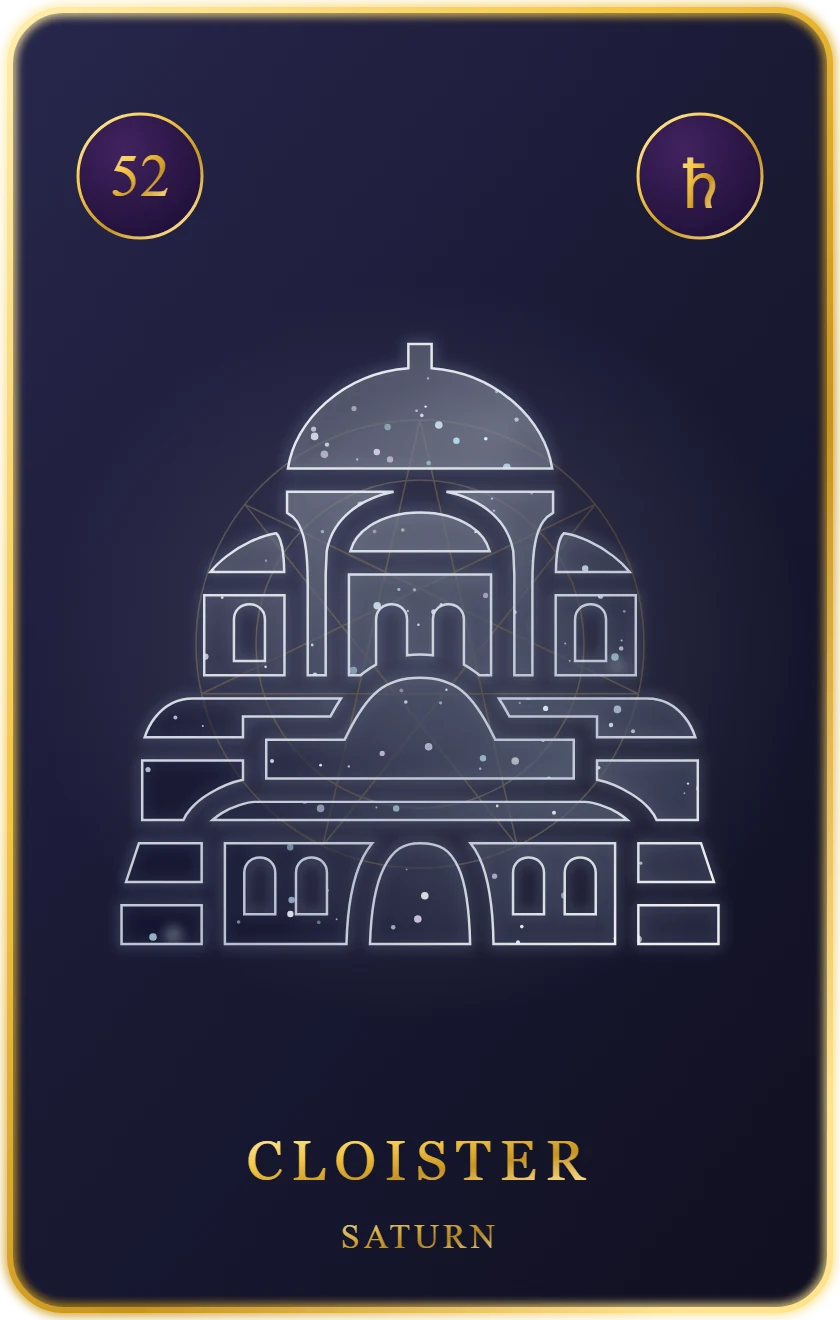
Meaning
Cloister names isolation, withdrawal, retreat chosen or endured. It is not a card of escape: the retreat it describes opens a space, that of introspection and recentering. What closes off on the outside reopens on the inside, provided one enters it with eyes open.
Cloister is card 52, the last of the Saturn series (46 to 52), which closes the series on solitude. It follows directly after Delay (51), which slows the pace, and neighbors Ruin (50), whose material collapse finds an inner counterpart in Cloister: what crumbles outside can be reworked inside, in silence rather than urgency. The card also speaks with Penates, card 16 of the lunar series: the hearth of Penates protects through family warmth and the presence of loved ones, while the Saturnian cloister isolates to allow a transformation that the hearth, by its very warmth, does not always make possible.
In a present day reading, Cloister points to a recognizable movement of withdrawal: distance taken from the noise of daily life, a need for silence, a period spent apart in order to see more clearly. This withdrawal can be chosen, a decision to recenter before acting, or imposed by circumstances, an isolation that settles in without being sought. The card does not decide between the two: it names the state, and leaves the querent the task of recognizing which of the two they are going through.
What makes the difference is not solitude itself but the awareness one has of it. A withdrawal inhabited, where you know why you are stepping back and what you are looking for there, opens onto clarity and recentering. A withdrawal endured without being named closes in on itself and can cut you off from useful support. Cloister invites you to look at this precise point: does this withdrawal still serve you, or is it time to step out of it.
Keywords
- Isolation
- Withdrawal into oneself
- Retreat, chosen or endured
- Introspection
- Inner recentering
- Inhabited silence
- Solitude that isolates or elevates
When this card appears in a reading
Drawn alone, as advice for the moment, Cloister invites you to name the withdrawal underway rather than endure it unseen: ask yourself whether this silence is chosen and what it allows you to clarify before acting.
In the four card abridged spread (you, your intimate life, your relationships, your status), its position shifts the reading. In the “you” position, it questions your need for inner withdrawal, what your silence still has to tell you. In the “relationships” position, it can signal a distance you are taking, which is not a rejection but a necessary space. In the “status” position, it marks a withdrawal from the visible scene, a time spent outside public action.
In the seven card spread, its proximity to Delay confirms a deliberate slowing down, a pause that takes the time it needs. Its proximity to Ruin links the withdrawal to an earlier loss, the retreat becoming the place where what has collapsed is reworked. Its proximity to Penates situates the choice between the warmth of a shared home and a recentered solitude. Cloister does not say how long the retreat lasts, it only situates where it plays out.