Meaning
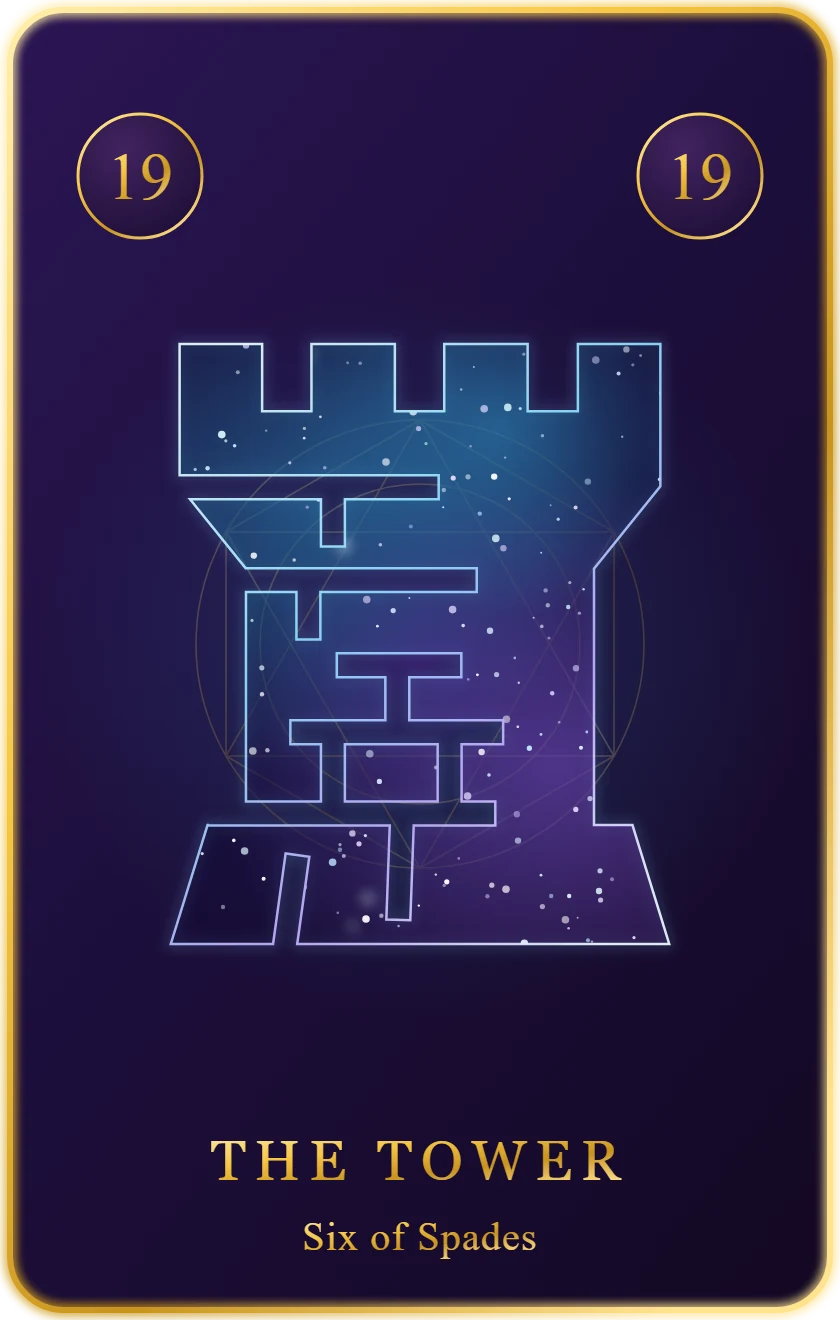
The Tower is card 19 of the Petit Lenormand, and its word first designates a building: a tall construction, isolated, visible from afar and hard to enter. From that very concrete image come three uses that return constantly in a reading.
The first is the institution. A tower is a headquarters, an administration, an organisation that lasts and has its own rules. The card names the school, the hospital, the bank, the court, the company seen as a structure rather than as a team. What happens there is framed, official, written down somewhere.
The second is distance. You climb a tower to see from high up and far off. The card therefore names the act of stepping back, of considering a situation from the outside, the observing position that shelters you from the immediate noise.
The third is solitude. A tower is a separate place. Depending on context, that separation is a refuge or an isolation. The Tower does not decide between the two, it records the distance.
Not to be confused with the House of God in the Tarot de Marseille. There too a tower appears, but it is struck and emptied of its occupants. In the Lenormand, the Tower stays standing, and that is exactly its meaning: it names institution, distance and solitude, never a brutal collapse. The Lenormand is literal where the tarot is symbolic.
A note on method. The Tower describes a position, not an event: it says that something is held at a distance, without saying what will become of it. And like every card in this deck, on its own it gives one word only. With the Heart, the distance is emotional. With the Letter, it becomes administrative. The neighbour states which kind of height is meant.
Playing card and traditional reading
The Tower carries the inset of the Six of Spades. This correspondence comes from the thirty-six card piquet deck that originally doubled the Petit Lenormand, and it is stable in the Dondorf line.
In the German school, the Spades suit points to what constrains, weighs or imposes a framework: obligations, procedures, what is faced rather than enjoyed. Applied to this card, it confirms the institutional reading and cools any purely contemplative reading of distance: the remove the Tower speaks of costs something, in time, in paperwork or in isolation.
Some modern editions no longer print this inset. The correspondence remains valid for the reading, it is simply absent from the artwork.
Key combinations
The Lenormand is read in pairs, and the grammar is fixed: the first card is the noun, the second the qualifier. The Tower followed by the Letter speaks of official mail. The Letter followed by the Tower speaks of a written text that creates distance. Same pair, two sentences.
| Combination | Reading |
|---|---|
| The Tower + The Heart | An emotional distance, a withdrawal of affection |
| The Tower + The Letter | Administrative mail, an official document |
| The Tower + The Tree | A hospital, institutional care |
| The Tower + The Book | An administration, a file to be processed |
| The Tower + The Garden | A public institution, a collective official setting |
The full mechanics of pairs are set out on the page about reading by combinations.
Position in the Grand Tableau
Position 19 in a Grand Tableau is the house of the Tower: the institution, the step back.
The card that lands there indicates which institution is meant, or what the distance applies to. The Tree in the house of the Tower points to a care setting, the Book to a file or a training course, the Heart to a bond kept at arm’s length. When the Tower falls in its own house, the official framework dominates the reading and leaves little room for the informal.
The table of the thirty-six houses and the three tableau formats are set out on the page about the Grand Tableau.
Keywords
| Register | Words |
|---|---|
| Core meaning | What stands apart, high up and withdrawn |
| Institution | Administration, official authority, organisation, framework |
| Distance | Height, overview, stepping back, observation |
| Solitude | Isolation, withdrawal, separation, shelter |
| Duration | Stable, long standing, hard to move |