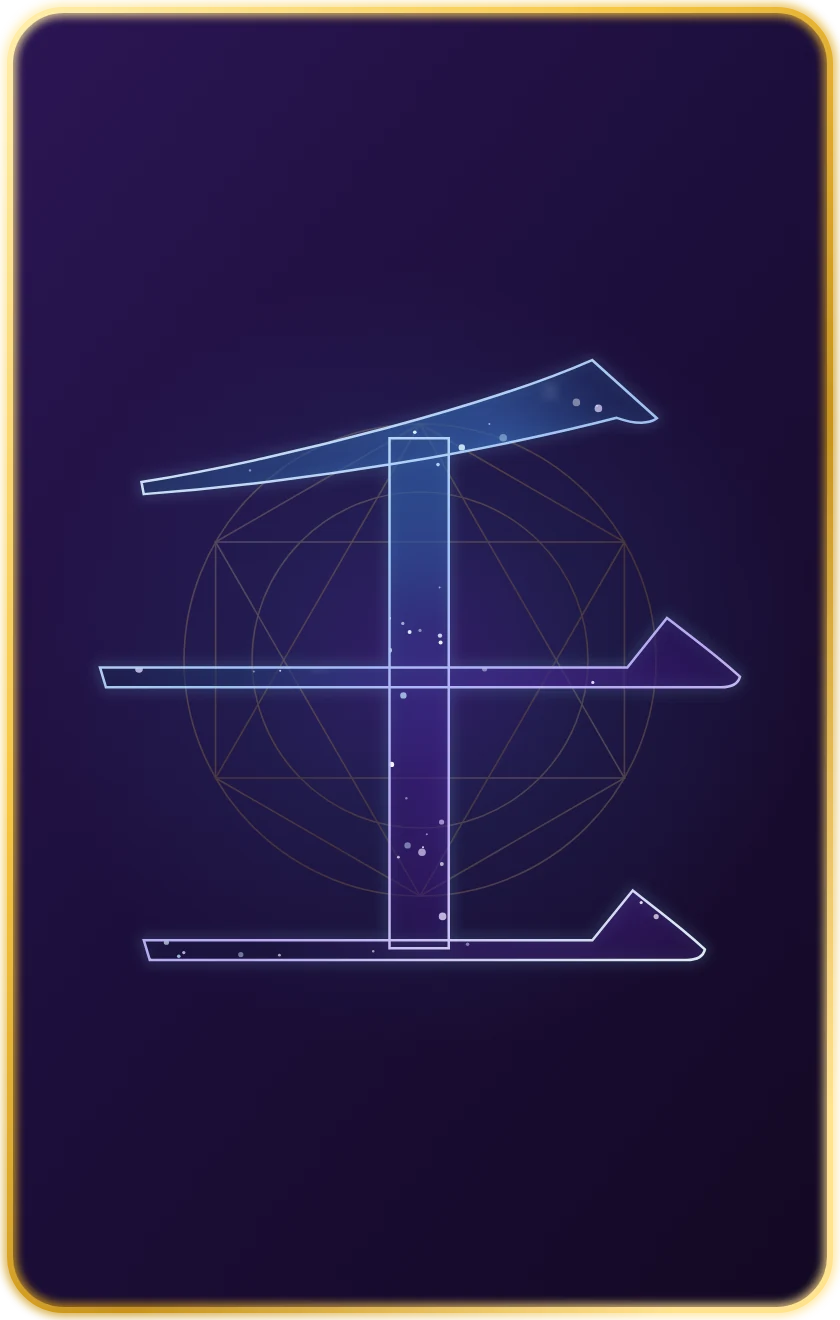
The stem and its image
Ren is the ninth of the ten heavenly stems, and its classical image is the ocean, the great river. Two images for one single idea: water whose edges cannot be seen, and which is going somewhere.
What the image gives first is breadth. The water of Ren is not a content, it is a volume. It carries, it transports, it absorbs without being troubled what a small pond would not stand for a minute. A Ren temperament sees wide, tires quickly of detail and prefers a large scale problem to a well bounded task. This is not negligence, it is a question of scale: below a certain size, the subject does not reach it.
Then comes movement. A river that stops ceases to be a river and becomes a pond. Ren needs to circulate, to learn, to change ground, and its intelligence is that of the current: rather than forcing the obstacle, it goes around it and carries on its way. One recognises it by its speed of understanding as much as by its refusal of imposed roads.
The word the corpus keeps is ungraspable, and it holds in the literal sense. Water will not be contained: a promise too narrow, a frame too rigid, a role assigned once and for all, everything that claims to enclose Ren ends up leaking on one side. That is its freedom, and it is also its difficulty. One does not hold the ocean in one hand, and Ren itself does not always manage it: what it has to learn, it learns by giving itself a bed, not dykes.
Element and polarity
Ren carries Water in its Yang phase. The ten stems distribute the five elements into two phases each, and the Yin side of Water is the stem Gui, which comes immediately after Ren and closes the series of ten. The two share the element without sharing the manner: Ren is the water that carries, Gui the water that seeps in.
Yang means neither strong nor masculine. It is a phase, not a gender: expansive, turned outward, occupied with extent rather than with fineness. Yang Water is measured by its flow and its reach. It is worth what it can take on board, not the precision with which it works its way in.
Where it hides
An earthly branch is never a simple block: it shelters one or more heavenly stems, called hidden stems, which give the pillar its real colour. Ren hides in three branches, at very different ranks.
In the branch Hai, that of the Pig, it stands in first rank. That is where it is at home: the branch gives it its full volume, and the pillar takes on the mobile breadth that characterises this stem.
In the branch Chen, that of the Dragon, and in the branch Shen, that of the Monkey, it stands in third rank. It leads nothing there, it leaves a reserve: a deep water, present but not setting the tone of the pillar.
As Day Master
The stem of the day pillar carries a name of its own: it is the Day Master, the character from which everything else is read. To be born with Ren in that place is not to receive a destiny, it is to receive a way of occupying space.
A Ren Day Master thinks in volume and in trajectory. It takes on more than it is asked for, understands fast, links fields that had no reason to meet, and puts up badly with being assigned a definitive place. Its asset is carrying capacity: it holds situations that would swamp others. Its difficulty is the exact counterpart, the commitment that lasts and the frame that holds, because nothing retains water without giving it a shape.
What this stem indicates covers only one of the eight characters. The seven others, starting with the branch of the same day pillar, change how it comes out. That is also what separates this reading from the yearly Chinese horoscope: the year animal is likewise only one character out of eight, and it is not this one.
Keywords
- Breadth
- Movement
- Intelligence
- Ungraspable
- Freedom