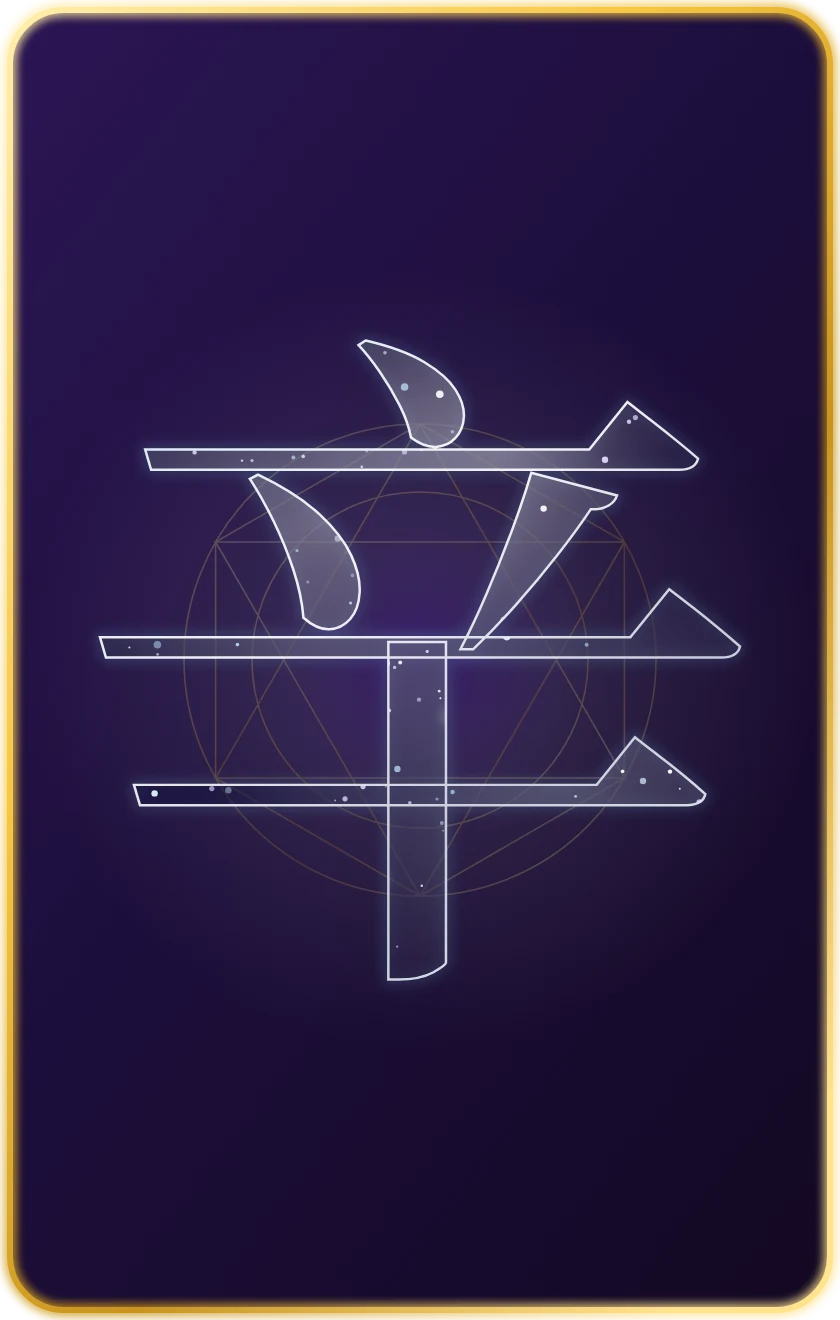
The stem and its image
Xin is the eighth of the ten heavenly stems, and the classical image attached to it is the jewel, polished metal. It deserves a pause, because it sets aside everything one spontaneously associates with metal. A jewel does not cut, does not pierce, carries no load. It was not made to act on the world. Its value lies entirely in what has been done to it: the cutting, the polishing, the adjustment to the tenth. Xin is refined metal whose value lies in the finish.
The temperament that follows begins with taste. Xin sees what others let pass: the detail that jars, the approximate word, the half tone that clashes. That sharpness is not severity, it is a demand for rightness, and it applies first of all to itself. Work that Xin has not finished is not yet work, it is still raw material.
From there comes distinction, in both senses of the word. Xin distinguishes, it separates the right from the nearly right, and that capacity ends up showing in the bearing, the manner, the way of saying things. Nothing there is ostentatious. The refinement of Xin is a refinement of subtraction: what it takes away counts more than what it adds.
The reverse side lies in the same image. A polished surface keeps the mark of the slightest scratch. Xin takes badly what nicks it and holds on to it a long time. Its touchiness is not a weakness of character, it is the exact counterpart of its fineness: whoever perceives finely also perceives finely what hurts them.
Element and polarity
Xin carries Metal in its Yin phase. The ten stems distribute the five elements into two phases each, and the Yang side of Metal is the stem Geng, which comes immediately before Xin in the order of the ten. The two share the material and do not put it to the same use: Geng is the metal that work has not taken hold of yet, Xin the one that work has made precious.
Yin means neither weak nor feminine. It is a phase, not a gender: concentrated, turned inward, occupied with form rather than with expansion. Yin Metal is measured by its density and its precision, never by its mass. A scalpel does not have the force of an anvil, it has something else, and that something else is what Xin brings into play.
Where it hides
An earthly branch is never a simple block: it shelters one or more heavenly stems, called hidden stems, which give the pillar its real colour. Xin hides in two branches only.
In the branch You, that of the Rooster, it stands in first rank. That is where it is at home: the branch offers it its clearest ground, and the pillar takes on the careful edge that characterises this stem.
In the branch Xu, that of the Dog of the Chinese cycle, it stands in second rank. It does not lead the dance there, it adds a note: a demand for form inside a branch that is not defined first of all by Metal.
These two presences are enough to spot Xin among the eight characters even when no visible stem carries it.
As Day Master
The stem of the day pillar carries a name of its own: it is the Day Master, the character from which everything else is read. To be born with Xin in that place is not to receive a destiny, it is to receive a point of view.
A Xin Day Master approaches things by quality rather than by volume. It prefers to do less and to do it well, chooses its commitments with care, puts up badly with sloppy work and judges itself by the finish. Its asset is discernment: sorting, adjusting, refusing what is not up to standard. Its fatigue is never quite finding the adjustment sufficient.
What this stem indicates covers only one of the eight characters. The seven others, starting with the branch that goes with that same day pillar, change how it comes out. That is also what separates this reading from the yearly Chinese horoscope: the year animal is likewise only one character out of eight, and it is not this one.
Keywords
- Refinement
- Precision
- Taste
- Touchiness
- Distinction