Meaning
The Dog at issue here is the eleventh animal of the Chinese cycle, the earthly branch Xu. It must not be confused with the Dog of the Petit Lenormand, card 18 of that deck: one is a calendar marker used to compose a BaZi chart, the other is a European cartomancy card. Both speak of faithfulness, and that kinship of vocabulary is all they share.
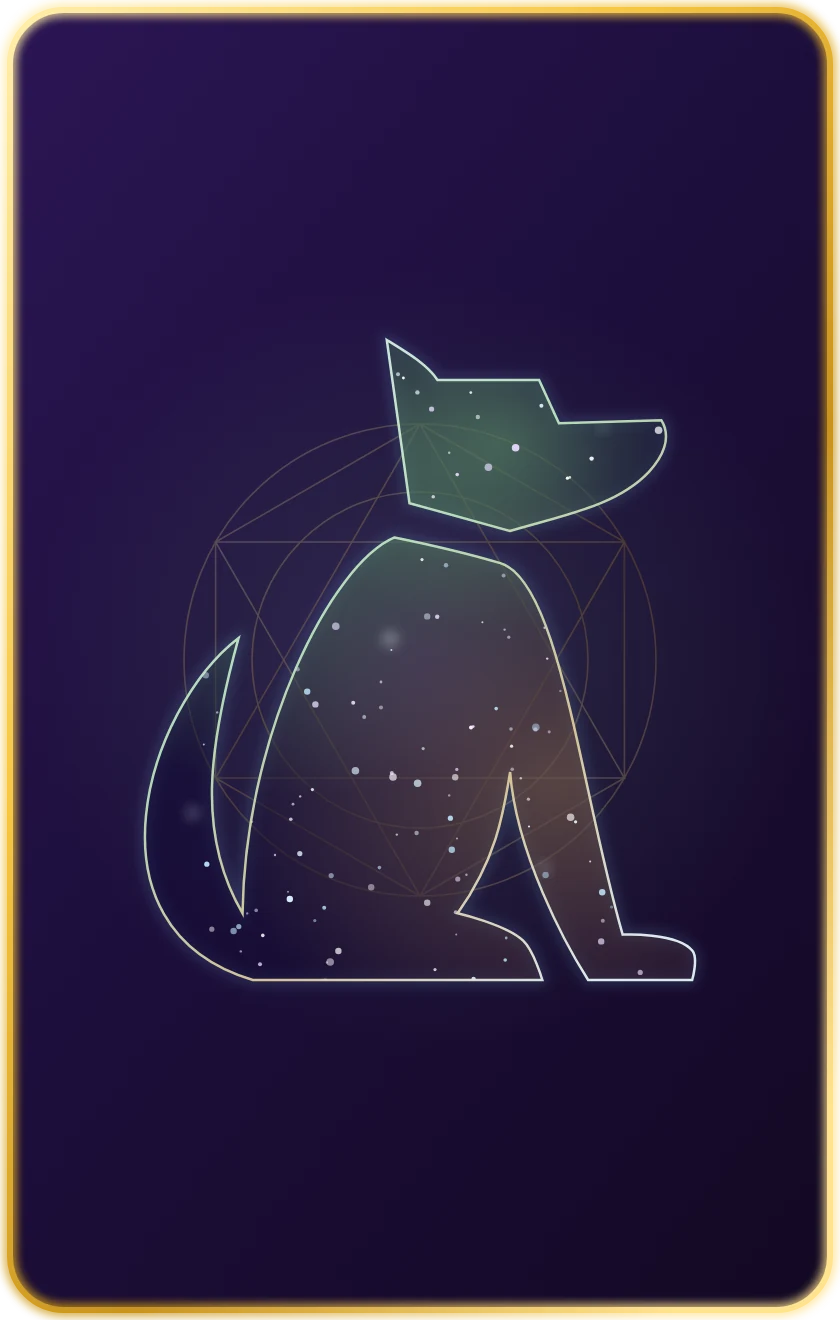
The theme of the Dog fits in one sentence: the loyalty that judges the world by the measure of justice. The nuance counts. The Dog is not faithful out of attachment, it is faithful because it considers that to be right, and on the day justice and attachment part ways, justice wins. From there comes its uprightness, and from there comes its intransigence too.
The second trait is protection. The Dog places itself spontaneously between what threatens and what it holds to be vulnerable, including when nobody asked. Its Earth is massive: it shelters, it does not move, it holds the position for a long time.
The third trait is worry, and it is the price of the first two. Keeping watch means anticipating what can go wrong, and that vigilance does not switch off easily. The Dog broods, suspects, checks. It wears itself out standing a guard nobody assigned to it.
A methodological note, valid for all twelve signs. The animal of the year is only one character out of the eight in a BaZi chart: the branch of the year pillar. The month, the day and the hour carry their own characters, which can soften this portrait as much as harden it.
The branch and its element
The branch Xu carries Earth Yang. It is one of the four Earth branches of the cycle, along with Chou (the Ox), Chen (the Dragon) and Wei (the Goat).
Xu hides three heavenly stems, and that is what gives the sign its thickness. Wu, Earth Yang, is the dominant stem: it is the mountain, the massive earth that shelters and does not move. Watch the name: this stem Wu is not the branch Wu, the Horse’s. Two different Chinese characters are romanised the same way, and nothing allows one to be deduced from the other.
Xin, Metal Yin, is the second hidden stem: polished metal, sorting, the sense of what is worth something and what is not. It is Xin that arms the Dog’s judgement.
Ding, Fire Yin, is the third: the lamp flame, a concentrated fire that lights one point. It is that Fire the San He trine of the next section comes to look for in the branch.
The Dog holds the ninth BaZi month and the direction West-Northwest.
Alliances and clashes
Three relations structure the branch Xu. There are no others.
The Liu He alliance, the union of six, ties the Dog to the Rabbit, branch Mao. The pair produces Fire: the meeting does not reinforce the Earth of the Dog, it lights something else. It is an alliance that transforms.
The Liu Chong clash sets the Dog against the Dragon, branch Chen, the one that faces it on the cycle. Two Earths confronting each other: the opposition here does not bear on the element but on the manner, and it describes a tension of axis, not a fate.
The San He trine gathers the Tiger (Yin), the Horse (branch Wu, not to be confused with the stem of the same name) and the Dog (Xu). Together the three branches produce Fire, and the Dog holds the closing place in it, the one where Fire settles rather than leaps.
These relations hold between branches, not between people. Two charts are neither matched nor opposed because their years carry the Dog and the Dragon: BaZi reading is done on eight characters, of which the year supplies only two.
Key facts
| Item | Value |
|---|---|
| Earthly branch | Xu, 11th of the cycle |
| Element and polarity | Earth Yang |
| Hidden stems | Wu (Earth Yang), Xin (Metal Yin), Ding (Fire Yin) |
| Double hour | 7pm - 9pm |
| BaZi month | 9th month (October, after Hanlu) |
| Season | Autumn |
| Direction | West-Northwest |
| Liu He alliance | Rabbit (Mao), the pair produces Fire |
| Liu Chong clash | Dragon (Chen) |
| San He trine | Tiger, Horse, Dog, which produces Fire |
The recent years of the Dog, with the heavenly stem that accompanies them:
| Year | Heavenly stem |
|---|---|
| 1946 | Bing (Fire Yang) |
| 1958 | Wu (Earth Yang) |
| 1970 | Geng (Metal Yang) |
| 1982 | Ren (Water Yang) |
| 1994 | Jia (Wood Yang) |
| 2006 | Bing (Fire Yang) |
| 2018 | Wu (Earth Yang) |
| 2030 | Geng (Metal Yang) |
| 2042 | Ren (Water Yang) |
The stem changes at every occurrence. In 1958 and in 2018 it doubles the element of the branch, since Wu is Earth Yang like Xu; in 1982 and in 2042 it brings Water. Two Dogs born twelve years apart therefore do not carry the same year pillar.
Keywords
- loyalty
- justice
- protection
- worry
- uprightness