Meaning
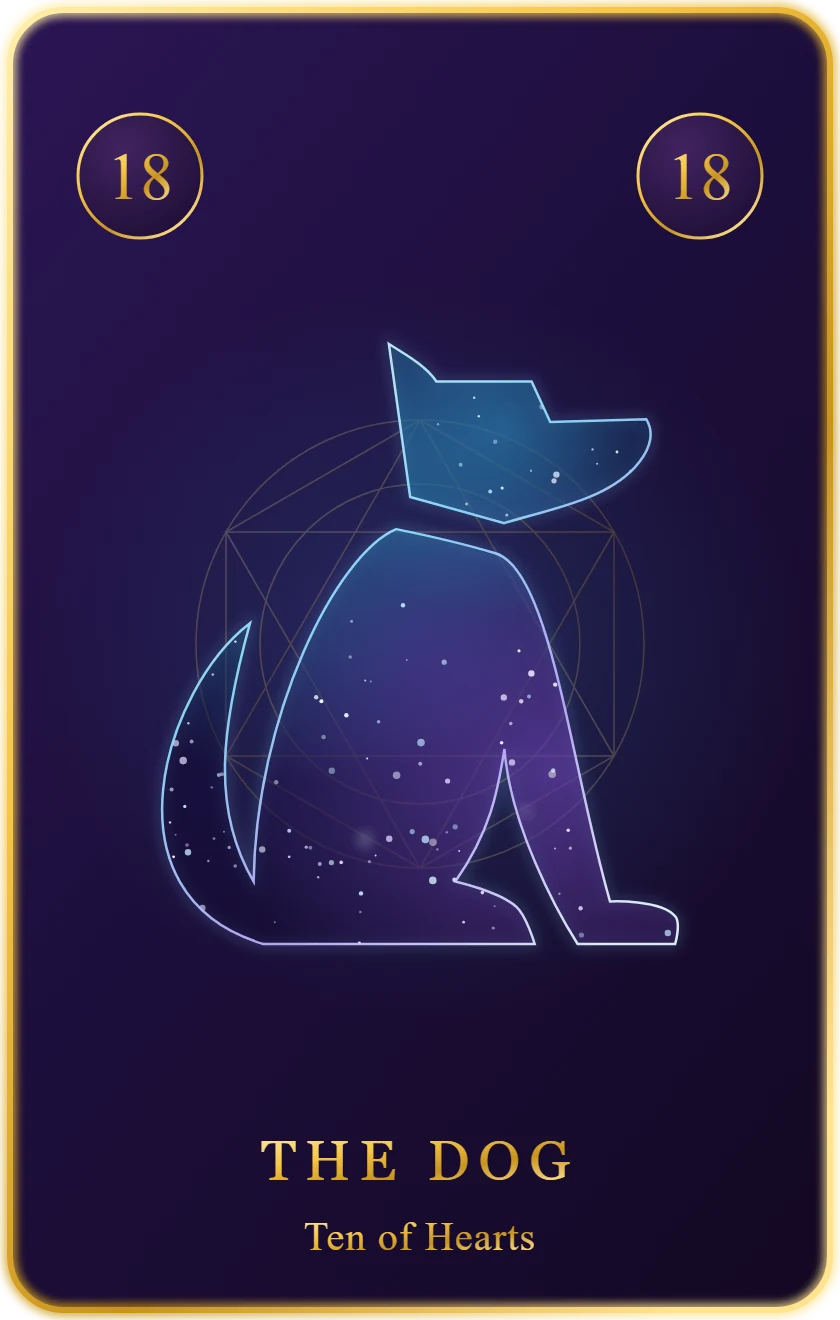
The Dog is card 18 of the Petit Lenormand, and its word is loyalty. Not loyalty in the moral sense of a promise kept, but in the concrete sense of a presence that stays: the person you can count on, what does not move when everything else changes.
The card works on two levels. It often denotes a person: the friend, the ally, the trusted relative, the one who accompanies without asking for anything. It also qualifies, more simply, the nature of a bond: loyal, safe, lasting. The neighbour settles between the two registers, as almost always in this deck.
On decks of the Dondorf line, around 1890, the card shows an attentive dog, often turned towards the viewer, sometimes sitting near a house. The imagery insists on attention more than on action: the dog looks, it is there, it does not go away. It is that quality of availability that makes the meaning of the card, and not an idea of service or obedience.
The area of life concerned is that of relationships that last: old friendships, stable professional backing, people in the immediate circle whom the person leans on without thinking about it. The Dog rarely speaks of a recent meeting. It speaks of what has been tested by time.
A note on method. The Dog guarantees nothing. It names a reliable presence in the situation, it does not promise that this presence will act, nor that it will be enough. And it lets itself be qualified like the others: with the Snake, loyalty itself is called into question. A single card gives a word, not a reading, and that rule holds here more than elsewhere, because trust is precisely what gets verified in context.
Playing card and traditional reading
The Dog carries the inset of the Ten of Hearts. This correspondence comes from the thirty-six card piquet pack that doubled the Petit Lenormand at the outset, and it is stable in the Dondorf line.
In the German school, the suit of Hearts ties the card to the emotional and relational register. That is consistent with its word: the loyalty of the Dog engages the bond, the attachment, being there for someone, rather than the contract or self interest. Professional backing read through the Dog stays personal backing, carried by a relationship and not by a function.
Some modern editions do not print this inset and replace it with a quatrain or with nothing at all. The correspondence still holds for the reading, it is simply absent from the artwork.
Essential combinations
The Lenormand is read in pairs, and the grammar is fixed: the first card is the noun, the second the qualifier. The Dog followed by the Heart speaks of a friendship taking on a romantic shade. The Heart followed by the Dog speaks of a love that rests on loyalty. Two different sentences with the same words.
| Combination | Reading |
|---|---|
| The Dog + The Heart | A loving friendship, a loyal attachment |
| The Dog + The House | A friend close to the home, family support |
| The Dog + The Snake | Loyalty called into question, an ambiguous friend |
| The Dog + The Crossroads | A friend who helps you choose, someone alongside you |
| The Dog + The Anchor | A lasting friendship, support that holds over time |
The full mechanics of pairs are set out in reading by combinations.
Position in the Grand Tableau
Position 18 of a Grand Tableau is the house of the Dog: the friend, what can be leaned on.
The card that lands there indicates where the support comes from, or what kind it is. The Fox in the house of the Dog points to professional backing that is better verified, the Anchor to support established long ago, the Mice to a trust quietly crumbling. When the Dog falls in its own house, friendship takes a central place in the reading.
The table of the thirty-six houses and the three tableau formats are set out on the Grand Tableau page.
Keywords
| Register | Words |
|---|---|
| Core meaning | The person you can count on |
| Bond | Friendship, trust, loyalty, attachment |
| Person | Friend, ally, reliable relative, companion |
| Quality | Presence, constancy, availability, support |
| Duration | Tested by time, stable, long standing |