Meaning
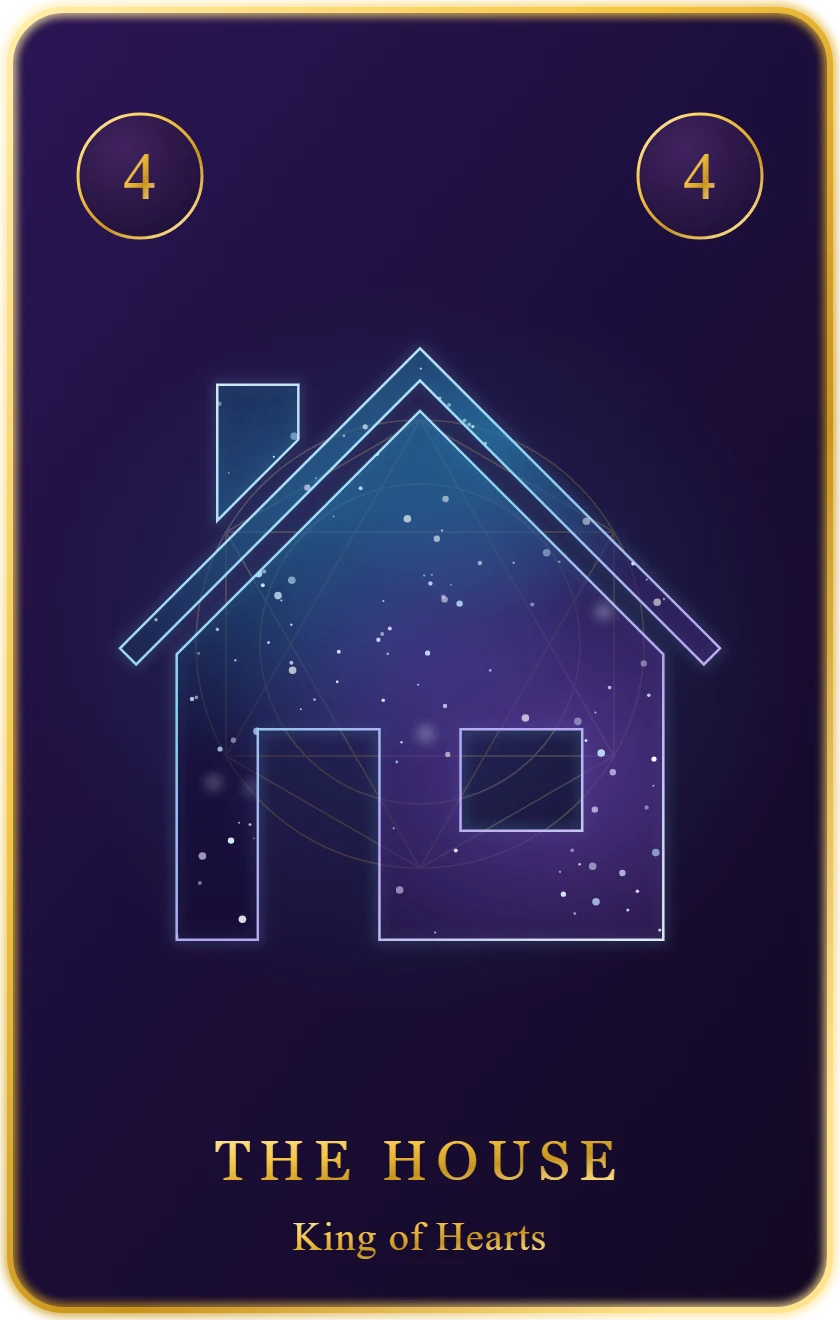
The House is card 4 of the Petit Lenormand, and its word is home.
It has to be heard in the most concrete sense. The House does not speak of a need for inner security or of a psychic space: it names a dwelling, an address, a family, a domestic circle. The Lenormand is literal, and this card particularly so. When it comes up on a housing question, it speaks of housing. When it comes up on a couple question, it speaks of shared daily life and of what plays out under one roof.
Not to be confused with the astrological houses, which are twelve sectors of the birth chart and have nothing to do with this card. The overlap in vocabulary is misleading, all the more so since the Lenormand also uses the word house for the thirty-six positions of the Grand Tableau. Three uses of the word, three independent systems.
On decks of the Dondorf line, around 1890, the card shows a solid middle class dwelling, often surrounded by a walled garden. The building is closed, planted, lasting. That is exactly the meaning of the card: what holds, what does not move, what one comes back to. The House is one of the most stable cards in the deck, almost the opposite of the Ship, which takes you away.
Two registers coexist. The place first: housing, property, a move when a card of movement accompanies it, questions of tenancy and ownership. Then the people: family, close relatives, those with whom daily life is shared. The two are linked in the German tradition, where the home means the walls as much as those who live within them.
A single card gives only a word, never a reading. The House does not say whether the home is happy: it says the home is the subject. The neighbours are what qualify, and they can just as easily speak of a home wearing thin as of a home settling in.
Playing card and traditional reading
The House carries the inset of the King of Hearts. This correspondence comes from the thirty-six card piquet pack that doubled the Petit Lenormand at the outset.
In the German school, the suit of Hearts turns the card towards feeling and bond. It prevents the House from being reduced to a property file: even on a housing question, the card keeps a dimension of inhabited home. The court figure of a king adds a note of assumed stability, the note of what structures a situation and holds the frame.
Some modern editions do not print this inset and replace it with a quatrain or with full artwork. The correspondence still holds for the reading, it is simply absent from the card face.
Essential combinations
The Lenormand is read in pairs, and the grammar is fixed: the first card is the noun, the second is the qualifier. The House followed by the Ship speaks of a home that moves. The Ship followed by the House speaks of a departure whose destination is the home.
| Combination | Reading |
|---|---|
| The House + The Tree | The health of the family, an old family root |
| The House + The Heart | A happy home, love settled under one roof |
| The House + The Ship | The home moves, a house move is taking shape |
| The House + The Key | Access to housing, a domestic matter that unlocks |
| The House + The Mice | The home wears thin, domestic worries nibble away |
The full mechanics of pairs are set out in reading by combinations.
Position in the Grand Tableau
Position 4 of a Grand Tableau is the house of the House: the home, the family, what shelters.
The card that lands there indicates what occupies the domestic sphere. The Mice in the house of the House point to the wear of daily life, the Key to a housing matter that unlocks, the Tree to a question of lineage. And when the House falls in its own house, the home is doubly at the centre of the reading.
The table of the thirty-six houses and the three tableau formats are set out on the Grand Tableau page.
Keywords
| Register | Words |
|---|---|
| Core meaning | The place where you live and the circle that lives in it |
| Place | Housing, property, address, roof, ownership |
| People | Family, close relatives, domestic circle, shared life |
| Quality | Security, grounding, stability, permanence |