Meaning
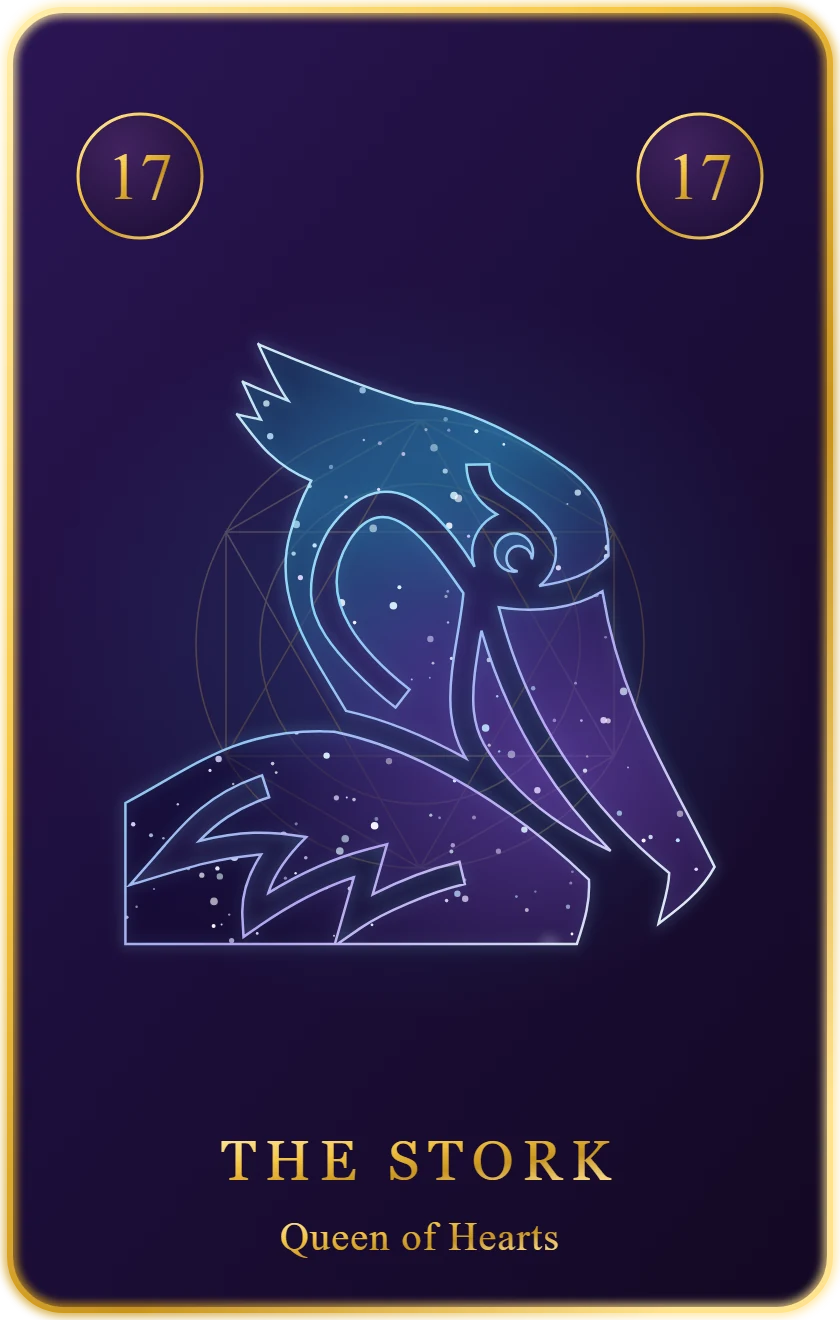
The Stork is card 17 of the Petit Lenormand, and its word is change. Not just any change: the kind that goes through a relocation. The stork migrates, leaves, comes back, rebuilds its nest elsewhere or in the same place but afresh. That is the mechanism the card carries: something changes place, and is transformed because it has changed place.
The distinction is useful in practice. A situation can evolve on the spot, through wear or through an internal decision: that is not the word of the Stork. It names a change of frame: you move house, you change post, you leave a town, you renew a bond by modifying what surrounds it. The relocation is concrete or organisational, rarely inward.
On decks of the Dondorf line, around 1890, the card shows the bird standing or in flight, often near a roof. The imagery insists on the nest and on seasonal passage, two ideas that go together: regular return and construction redone. From that comes the nuance of renewal, which distinguishes the Stork from a simple break.
A word on a frequent confusion. Popular imagery links the stork to the arrival of a child, and many guides make it a card of birth. The German school, the one this module follows, reads it first as change and renewal. A family question is read with the Child, with the House, with the context of the question, never with the Stork on its own.
Finally, the card is neutral. It does not say whether the change suits or disturbs, nor whether it happens quickly. With the Mountain it is delayed. With the Child it is nascent and still small. The verdict always comes from the neighbour, and a single card gives only a word.
Playing card and traditional reading
The Stork carries the inset of the Queen of Hearts. This correspondence comes from the thirty-six card piquet pack that doubled the Petit Lenormand at the outset, and it is stable in the Dondorf line.
In the German school, the suit of Hearts ties the card to the emotional and relational register. It gives an indication of terrain: the change the Stork speaks of concerns personal life, the home and bonds more often than strategy or calculation. It is a nuance of reading, not an absolute rule: the context of the question stays in charge.
Court figures are besides often read as people. A queen can therefore denote a woman who carries the change in the situation, or who is its vehicle.
Essential combinations
The Lenormand is read in pairs, and the grammar is fixed: the first card is the noun, the second the qualifier. The Stork followed by the Fox speaks of a change of post. The Fox followed by the Stork speaks of work that is itself being transformed. It is not the same sentence.
| Combination | Reading |
|---|---|
| The Stork + The House | A change of dwelling, a home that transforms |
| The Stork + The Fox | A change of post, a professional reorientation |
| The Stork + The Heart | An emotional renewal, a relationship that evolves |
| The Stork + The Mountain | A delayed change, a blocked transition |
| The Stork + The Child | A nascent change, a novelty settling in |
The full mechanics of pairs are set out in reading by combinations.
Position in the Grand Tableau
Position 17 of a Grand Tableau is the house of the Stork: what changes, what renews itself.
The card that lands there indicates the area where the change plays out. The House in the house of the Stork points to housing, the Fox to work, the Anchor to what might on the contrary stay in place. When the Stork falls in its own house, the change is clear and occupies the foreground of the reading.
The table of the thirty-six houses and the three tableau formats are set out on the Grand Tableau page.
Keywords
| Register | Words |
|---|---|
| Core meaning | What is transformed by changing place |
| Change | Evolution, transition, modification of the frame |
| Relocation | House move, transfer, departure, return |
| Renewal | Nest rebuilt, fresh start, cycle beginning again |
| Pace | Gradual, seasonal, in stages |