Meaning
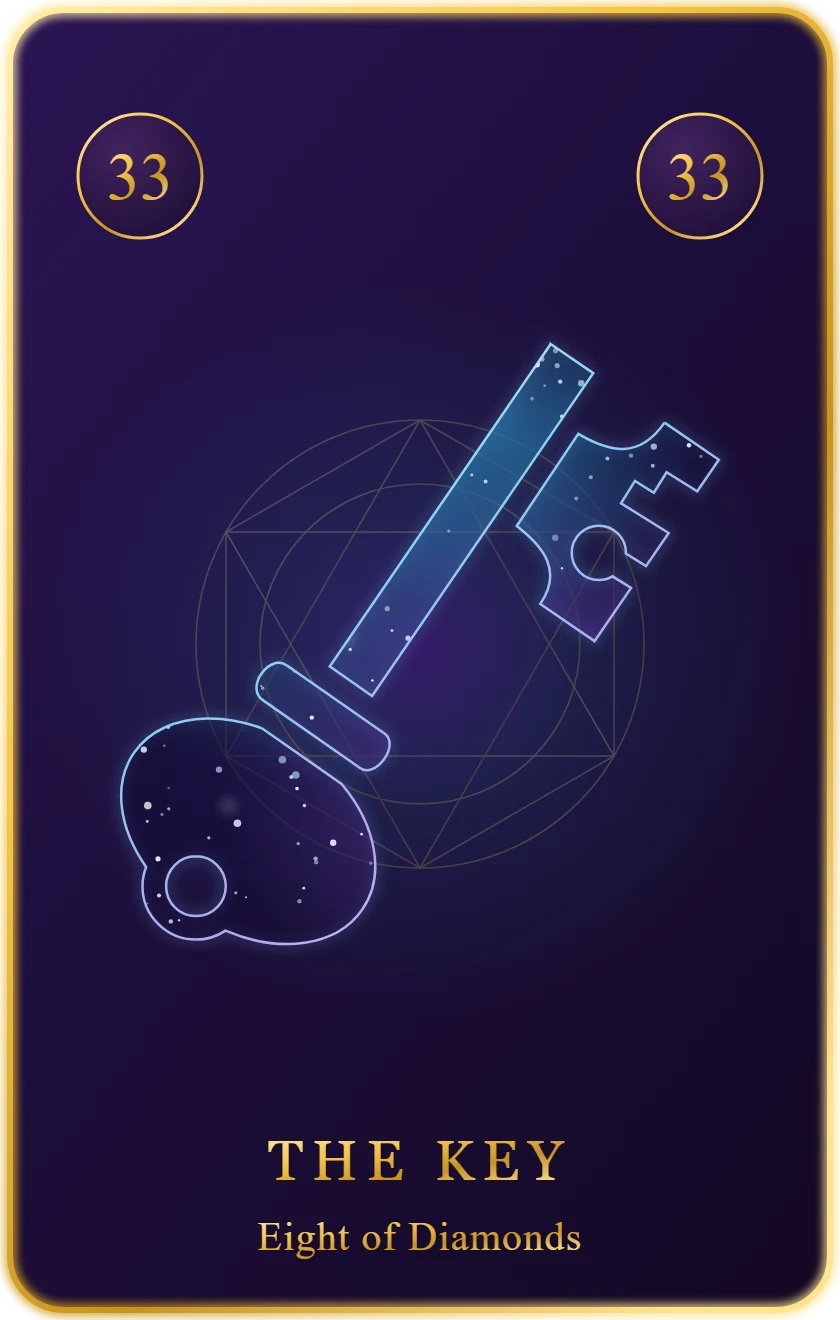
The Key is one of the most useful cards in the deck and one of the most discreet. It carries little content of its own: card 33 of the Petit Lenormand names the act of opening and the act of confirming, without saying what opens or what is confirmed.
The Lenormand is literal. A card is not a figure to meditate on, it is a word in a sentence, and the word of the Key is “yes, that is right”. It works as a validation: placed beside a card, it states that what that card names is settled, accessible, resolved.
Three uses come up in practice. The first is access: a door opens, an authorisation comes through, you obtain what was closed. The second is the solution: a problem finds its answer, a mechanism unlocks. The third is certainty: what was supposed becomes known, the hypothesis gives way to the fact.
On decks of the Dondorf line, around 1890, the card shows a single key, with no lock and no door. The image is consistent with the meaning: the tool is there, what it opens remains to be specified by the neighbouring cards.
This is why the Key in isolation gives almost nothing. Many readers treat it as the yes card in a closed question, and the practice is defensible, but it does not excuse reading it outside a pair. A single card gives a word, not a reading.
One nuance of posture, finally. The Key indicates that something is open, it obliges no one to walk through the door. It names a possibility that has become accessible, not an event that would occur by itself. That is the difference between observing that access exists and promising that it will be used.
Playing card and traditional reading
The Key carries the inset of the Eight of Diamonds. This correspondence comes from the thirty-six card piquet deck that originally doubled the Petit Lenormand, and it is fixed by the canonical table of the module, never deduced from the name of the card.
In the German school, the Diamonds suit points to the concrete: the material, the administrative, what can be observed and verified. That is a valuable indication here. What the Key opens is rarely an inner clarity, it is more often a file that moves forward, an agreement that comes through, a real door that unlocks.
Some modern editions no longer print this inset. The correspondence remains valid for the reading, it is simply absent from the artwork.
Key combinations
The grammar of the Lenormand is fixed: the first card is the noun, the second the qualifier. The Key followed by the Book speaks of an answer found to what was hidden, the Book followed by the Key speaks of knowledge that grants access. The two pairs do not say the same thing.
| Combination | Reading |
|---|---|
| The Key + The Heart | An emotional certainty, a confirmed love |
| The Key + The Fox | A professional door opening |
| The Key + The Mountain | A blockage giving way, an obstacle lifted |
| The Key + The Book | A secret revealed, an answer found |
| The Key + The House | Access to housing, a household matter settled |
The full mechanics of pairs are set out on the page about reading by combinations.
Position in the Grand Tableau
In a Grand Tableau, each place carries the meaning of the card whose number it holds. Position 33 is the house of the Key: what opens, certainty.
The card that lands there indicates the area where something is unlocking, or the one on which the person now has a firm answer. The Fox in the house of the Key points to professional access, the Mountain to an unlocking that has taken time.
The table of the thirty-six houses and the three tableau formats are set out on the page about the Grand Tableau.
Keywords
| Register | Words |
|---|---|
| Core meaning | What opens and confirms |
| Opening | Access, a door lifted, authorisation, unlocking |
| Resolution | Solution, answer, a mechanism giving way |
| Certainty | Confirmation, validation, what is settled |