Meaning
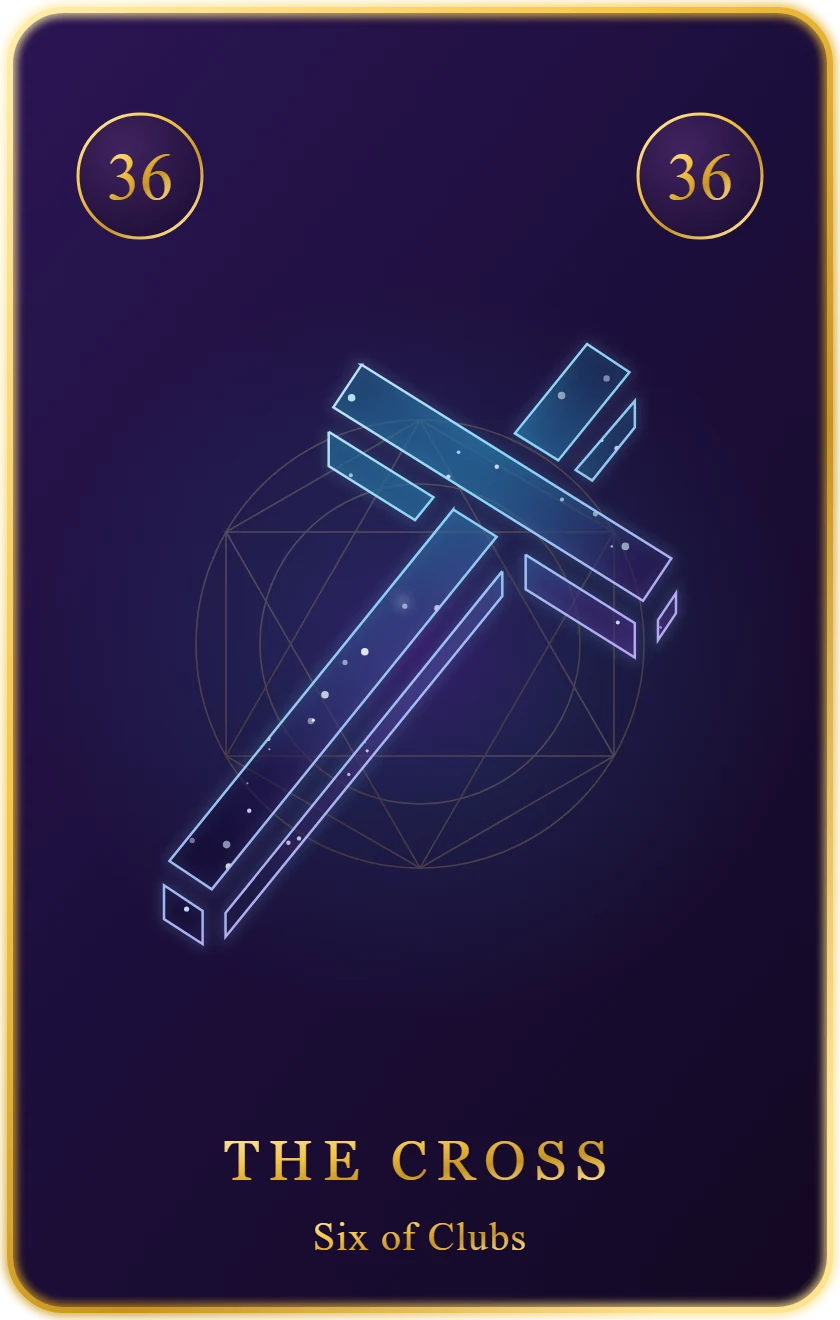
The Cross closes the deck: it is card 36 of the Petit Lenormand, the last of the series. That place gives it no particular authority over the others, but it explains why it is sometimes read as a full stop, which it is not.
Its word is simple and without emphasis: what weighs. A burden to carry, a heavy period, a passage you do not get to skip. The Lenormand is literal, and this card even more than the others needs to be read at ground level: it describes a weight, it does not deliver a verdict.
The name comes from the imagery of the deck, not from a religious reading. On decks of the Dondorf line, around 1890, the card shows a plain cross, often set in a landscape. Nothing in modern practice puts an idea of fault, punishment or expiation into it. What the card names is a real constraint, of the kind you carry for a while.
Three uses come up. The first is the burden: a responsibility, a heavy file, someone to support. The second is the ordeal: a difficult sequence, a moment that costs. The third is the compulsory passage: a stage you cannot go around and simply have to cross.
The word “cross” is the right one, and it is better than “endure”. The Cross names a time that is limited by nature. A burden is carried, then set down. That is what distinguishes it from a blockage, which does not move until something moves it.
One caution of posture, finally, because this card lends itself to dramatisation. The Cross announces nothing, it does not measure the seriousness of what it touches and does not say how long it will last. It signals that the subject has weight, that is all. Taken alone it gives one word only: its neighbour indicates what the burden is made of, and another neighbour can indicate that it lifts.
Playing card and traditional reading
The Cross carries the inset of the Six of Clubs. This correspondence comes from the thirty-six card piquet deck that originally doubled the Petit Lenormand, and it is fixed by the canonical table of the module, never deduced from the name of the card.
In the German school, the Clubs suit ties the card to daily life: current activity, work, ordinary concerns. That is a useful indication, almost a reassuring one. It places the burden in the concrete and the everyday rather than in the tragic, and it prevents reading the Cross as a fatality: what weighs is of the kind you carry from one day to the next.
Some modern editions no longer print this inset. The correspondence remains valid for the reading, it is simply absent from the artwork.
Key combinations
The grammar of the Lenormand is fixed: the first card is the noun, the second the qualifier. The Cross followed by the Fox speaks of a workload, the Fox followed by the Cross speaks of work that has become heavy. The two pairs do not say the same thing.
| Combination | Reading |
|---|---|
| The Cross + The Heart | A heartache, an attachment that hurts |
| The Cross + The Tree | A health ordeal, a body carrying the burden |
| The Cross + The Fox | Heavy work, a professional burden |
| The Cross + The Sun | The ordeal ends, the burden lifts |
| The Cross + The Whip | A painful conflict, a tension that wears you down |
The fourth line is worth noting: the Cross is not a card without a way out, and its neighbour can state its end. The full mechanics of pairs are set out on the page about reading by combinations.
Position in the Grand Tableau
In a Grand Tableau, each place carries the meaning of the card whose number it holds. Position 36 is the house of the Cross: the burden, what has to be crossed.
The card that lands there indicates what weighs in the situation, or the area that calls for endurance. The Fox in the house of the Cross points to a workload in one’s trade, the Tree to a fatigue of the body, the Sun to a burden growing lighter.
The table of the thirty-six houses and the three tableau formats are set out on the page about the Grand Tableau.
Keywords
| Register | Words |
|---|---|
| Core meaning | What weighs and has to be crossed |
| Burden | Responsibility, load, weight to carry |
| Ordeal | Difficult period, a moment that costs |
| Passage | Compulsory stage, constraint to cross, limited time |