Meaning
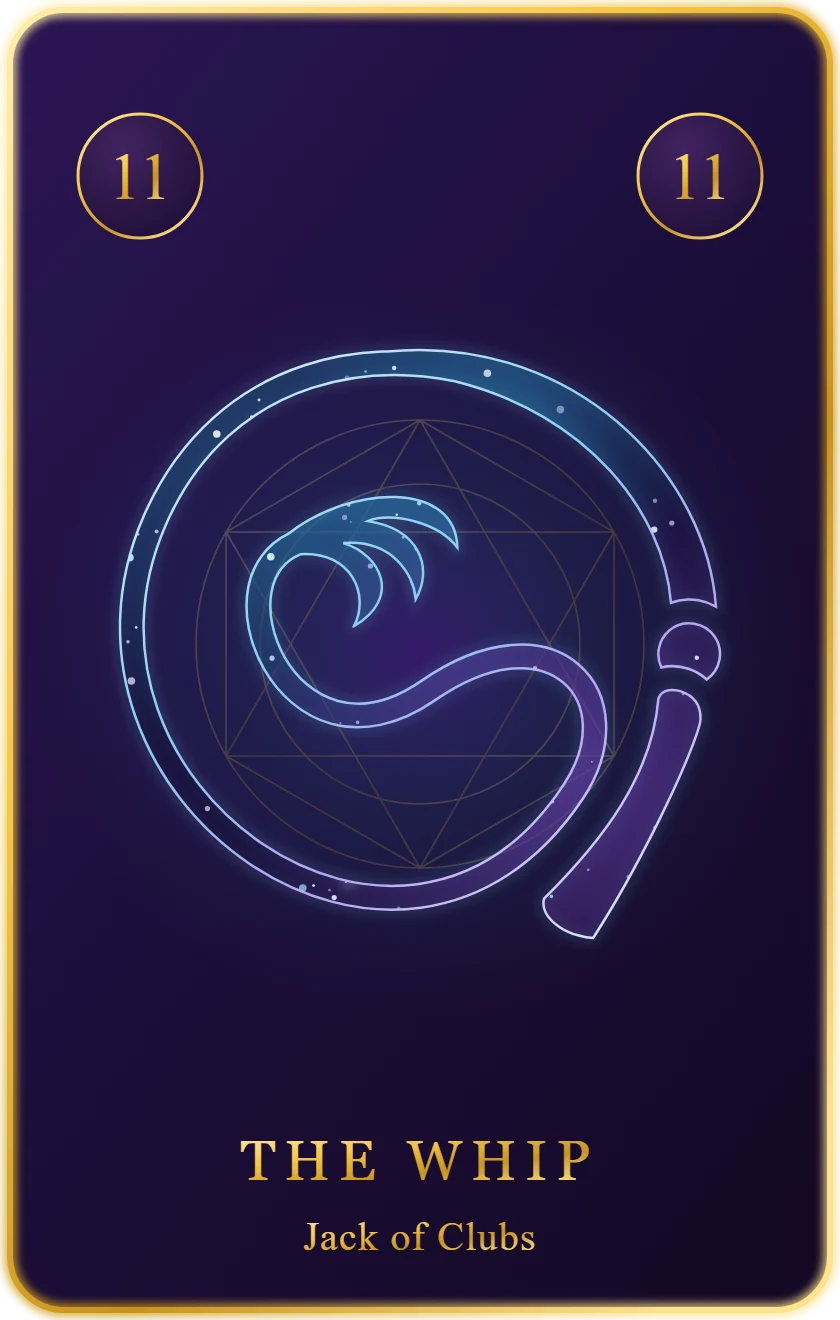
The Whip is card 11 of the Petit Lenormand, and its word is not the one people expect. It does not say violence, it says repetition. What comes back, what starts again, what is taken up one more time.
The name varies from edition to edition: The Rod, The Broom and The Birch are attested variants, and each puts a different object forward. What all these pictures share is the back and forth movement, the gesture played out again. It is that movement which carries the meaning, not the object itself. On decks of the Dondorf line, around 1890, the card shows the instrument alone, with no scene and no figures: nothing in it points to someone striking someone else.
Three registers share this word. The first is the heated discussion: an exchange that escalates, an argument that flares up again, a subject taken up without ever being closed. The second is useful repetition: training, revision, the gesture that has to be redone to be acquired. The third is physical effort: bodily expenditure, sport, work done with the arms, and the tiredness that comes with it.
These three registers look unrelated, and yet they hang on the same word: something does not happen once, it happens in a loop. That loop is what defines the card. The Whip does not say a conflict breaks out, it says it comes back.
A single card gives only a word, never a reading. The Whip indicates neither the seriousness of what repeats, nor its duration, nor its outcome. Its neighbour designates the area concerned, and the context of the spread says whether this is a conversation heating up, a learning routine or a pain that returns. The card names an insistence, it promises nothing.
Playing card and traditional reading
The Whip carries the inset of the Jack of Clubs. This correspondence comes from the thirty-six card piquet pack that doubled the Petit Lenormand at the outset, and it is fixed by the canonical table, not deduced from the artwork.
In the German school, the suit of Clubs points towards work, effort and everyday concerns. That usefully colours the card: the Whip speaks more readily of a tension that wears you down day after day, of training, of a repeated load, than of a passionate drama. The repetition it names is laborious before it is spectacular.
Some modern editions do not print this inset. The correspondence still holds for the reading, it is simply absent from the card face.
Essential combinations
The Lenormand is read in pairs, and the grammar is fixed: the first card is the noun, the second the qualifier. The Whip followed by the Book and the Book followed by the Whip do not say the same thing. In one case the repetition bears on learning. In the other, knowledge is built through repeated passes.
| Combination | Reading |
|---|---|
| The Whip + The Heart | A lovers’ quarrel, a tension that comes back |
| The Whip + The House | A domestic conflict, tensions at home |
| The Whip + The Tree | Physical effort, a recurring pain |
| The Whip + The Book | Learning through repetition, training |
| The Whip + The Cross | A confrontation that weighs, a deep seated conflict |
The full mechanics of pairs are set out in reading by combinations.
Position in the Grand Tableau
Position 11 of a Grand Tableau is the house of the Whip: what repeats, what gets argued over.
The card that lands there indicates the subject that keeps coming back and the area where the loop settles. The Fox in the house of the Whip points to a work friction played out again and again, the House to a family subject taken up endlessly. When the Whip occupies its own house, its word is reinforced: the repetition is obvious and nobody gets around it.
The table of the thirty-six houses and the three tableau formats are set out on the Grand Tableau page.
Keywords
| Register | Words |
|---|---|
| Core meaning | What comes round again and gets thrashed out |
| Repetition | Recurrence, resumption, routine, training |
| Heated exchange | Lively discussion, argument, disagreement flaring up again |
| Body | Physical effort, expenditure, endurance, tiredness |