Meaning
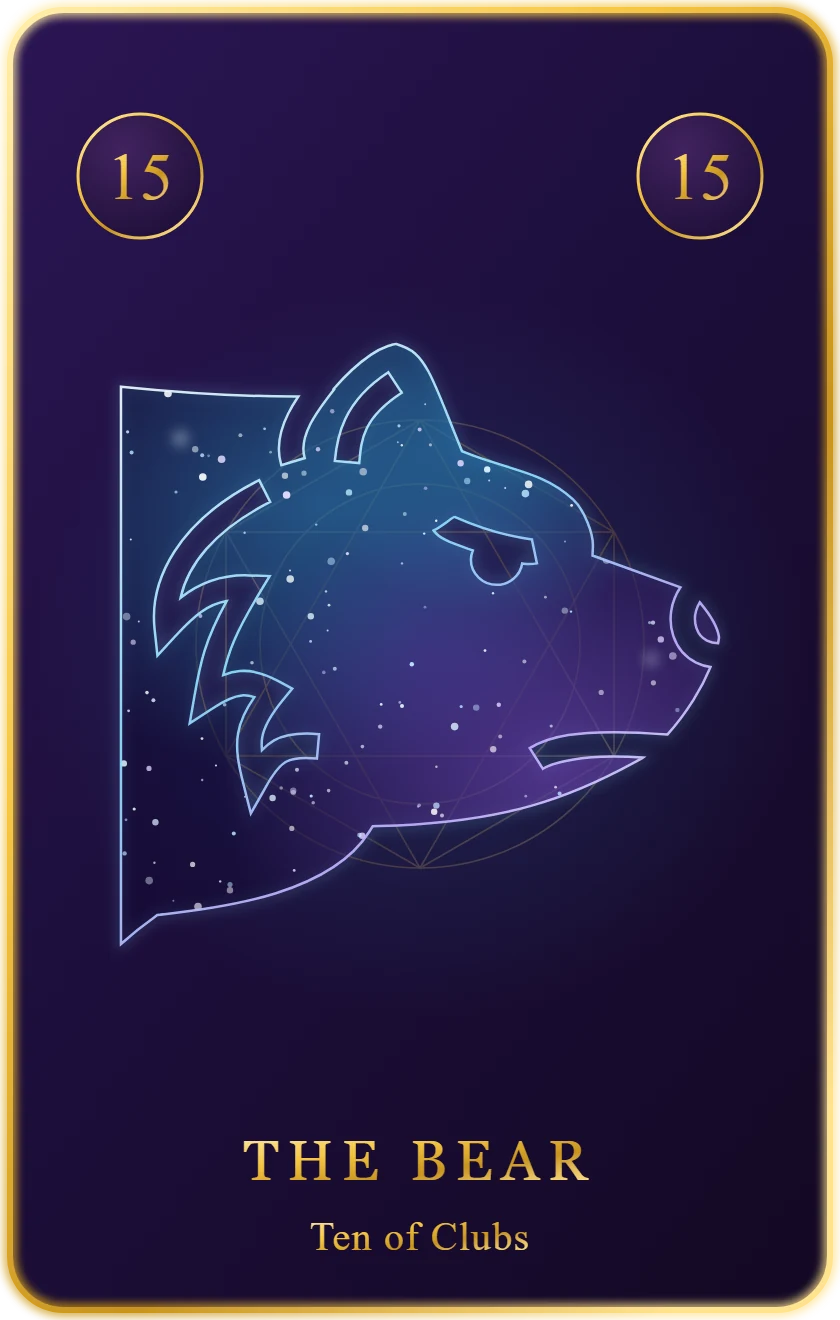
The Bear is card 15 of the Petit Lenormand, and its word is weight. The weight of whoever holds the strength, the means, or the authority to decide. Where other cards describe an action, this one describes a mass present in the situation.
On decks of the Dondorf line, around 1890, the animal is shown standing or three quarters on, imposing and motionless. The picture does not show an attack, it shows a presence. That is exactly what the card names: something or someone occupies the space and counts for more than the rest.
Three main readings come out of this word. The first is authority: a superior, a parent, an institution, a person whose opinion weighs on the decision. The second is resource: capital, reserves, accumulated material means, what can be leaned on. The third is protection: the figure who covers, defends, takes things on.
These three readings have one point in common, and it is the one to remember: in all three cases the strength sits on the card’s side, not on yours. The Bear does not say that you are powerful, it says that a power is in play. It can support you or constrain you, and the card does not settle that by itself.
This ambivalence is structural, it is not a flaw in the definition. A protector protects and imposes at the same time, capital opens doors and locks you into its conditions. The Lenormand is literal: it names the presence of that force without judging it, and the neighbouring card indicates which way it leans.
A single card gives only a word. The Bear promises neither support nor obstacle, it signals that the situation contains a point of support or a point of blockage, depending on what accompanies it, and that this point is heavy.
Playing card and traditional reading
The Bear carries the inset of the Ten of Clubs. This correspondence comes from the thirty-six card piquet pack that doubled the Petit Lenormand at the outset, and it is fixed by the canonical table, never deduced from the picture.
In the German school, the suit of Clubs points towards work, effort and everyday business. That pushes the card towards its most concrete readings: the line manager rather than the abstract figure, material means rather than moral strength. It is not an absolute rule, but a tendency worth knowing.
Some modern editions do not print this inset. The correspondence still holds for the reading, it is simply absent from the artwork.
Essential combinations
The Lenormand is read in pairs, and the grammar is fixed: the first card is the noun, the second the qualifier. The Bear followed by the Fox and the Fox followed by the Bear do not say the same thing. In one case the authority is the authority of work. In the other, work is marked by a dominant presence.
| Combination | Reading |
|---|---|
| The Bear + The Fish | A capital, substantial resources |
| The Bear + The Fox | A line manager, an authority at work |
| The Bear + The House | A protective figure of the home, a family estate |
| The Bear + The Mountain | An authority that blocks, an inflexible power |
| The Bear + The Man | A dominant and protective male figure |
The full mechanics of pairs are set out in reading by combinations.
Position in the Grand Tableau
Position 15 of a Grand Tableau is the house of the Bear: authority, what weighs with all its weight.
The card that lands there indicates where that strength comes from and what it is exercised on. The Fish in the house of the Bear point to material means, the Mountain to an authority that stands in the way, the Dog to a faithful protection. When the Bear occupies its own house, its word is reinforced: the power in play is visible and nobody gets around it.
The table of the thirty-six houses and the three tableau formats are set out on the Grand Tableau page.
Keywords
| Register | Words |
|---|---|
| Core meaning | The weight of whoever holds the strength or the means |
| Authority | Superior, decision maker, hierarchy, opinion that counts |
| Resources | Capital, reserve, estate, material means |
| Protection | Protective figure, support, strength that covers |