Meaning
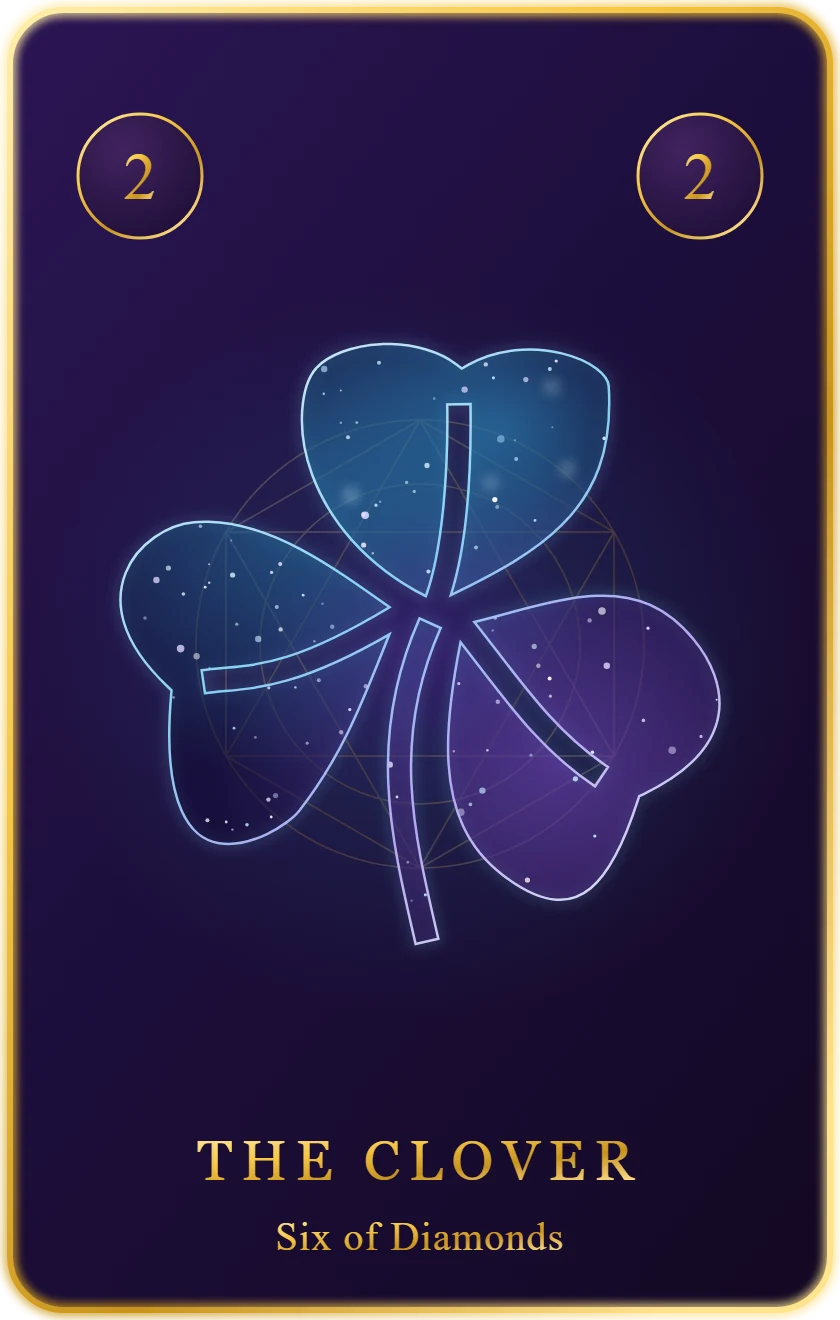
The Clover is card 2 of the Petit Lenormand, and its word takes very little space: a piece of luck, and it is short.
That nuance matters. The Clover does not say success, or fortune, or achievement that has settled in. It says a favourable opening that presents itself and will not stay open for long. A window, a slot, a bright spell. The right word would be windfall, provided you hear in it everything that is fleeting.
The Lenormand works this way: each card is a word in a sentence, not a figure to contemplate. The Clover is not the symbol of luck in general, it is the name of a precise, one-off, often modest opportunity. A single card never yields a reading anyway, only that word. It is the neighbour that says which kind of luck is meant and whether it holds.
On decks of the Dondorf line, around 1890, the card shows a four leaf clover on its own in the grass. The imagery clarifies the meaning: the extra leaf is a happy accident, an exception in an ordinary field. You find it, you do not manufacture it. The Clover has the same texture: it belongs to what turns up rather than to what gets built.
Two uses dominate in reading. The first is small concrete luck: a helping hand, a useful meeting, a favourable surprise. The second is timing: the card raises the question of the moment, it names a short duration. When you ask about a deadline, its presence leans towards the short, as the Rider’s does.
The Clover carries no moral value either. It rewards nothing and punishes nothing. It observes that a door is ajar. The rest of the spread indicates what lies behind it, and the context of the question always takes priority over the isolated word.
Playing card and traditional reading
The Clover carries the inset of the Six of Diamonds. This correspondence is surprising, and it is nonetheless the right one: the name of a card never determines its suit. The Clover of the Petit Lenormand does not belong to the Clubs suit of the piquet pack, it belongs to Diamonds.
In the German school, the suit of Diamonds turns the card towards the concrete, the everyday, what can be counted and handled. It anchors the Clover on the material side rather than the emotional one: a practical opportunity, a tangible advantage, more rarely a movement of the heart.
Some modern editions no longer print this inset and replace it with a quatrain or with full artwork. The correspondence still holds for the reading, it is simply absent from the card face.
Essential combinations
The Lenormand is read in pairs, and the grammar is fixed: the first card is the noun, the second is the qualifier. The Clover followed by the Mice and the Mice followed by the Clover do not say the same thing. In the first case, luck is what crumbles. In the second, wear and tear is briefly relieved.
| Combination | Reading |
|---|---|
| The Clover + The Clouds | Uncertain luck, a bright spell that does not last |
| The Clover + The Fish | A brief financial opportunity, an unexpected gain |
| The Clover + The Key | The opening is the right one, luck opens a door |
| The Clover + The Anchor | A small piece of luck that ends up settling in for good |
| The Clover + The Mice | An opening that crumbles if it is not taken quickly |
The full mechanics of pairs are set out in reading by combinations.
Position in the Grand Tableau
Position 2 of a Grand Tableau is the house of the Clover: where luck presents itself, the point of the spread at which an opening can appear.
The card that lands there indicates the channel this opening arrives through. The Fish in the house of the Clover point to a money opportunity, the Letter to a written proposal, the Mountain to a blocked chance that is slow to take shape.
The three tableau formats and the table of the thirty-six houses are set out on the Grand Tableau page.
Keywords
| Register | Words |
|---|---|
| Core meaning | A favourable opening, but a short lived one |
| Luck | Windfall, helping hand, bright spell, small opportunity |
| Concrete | Practical advantage, useful surprise, open window |
| Pace | Brief, passing, to be taken quickly |