Meaning
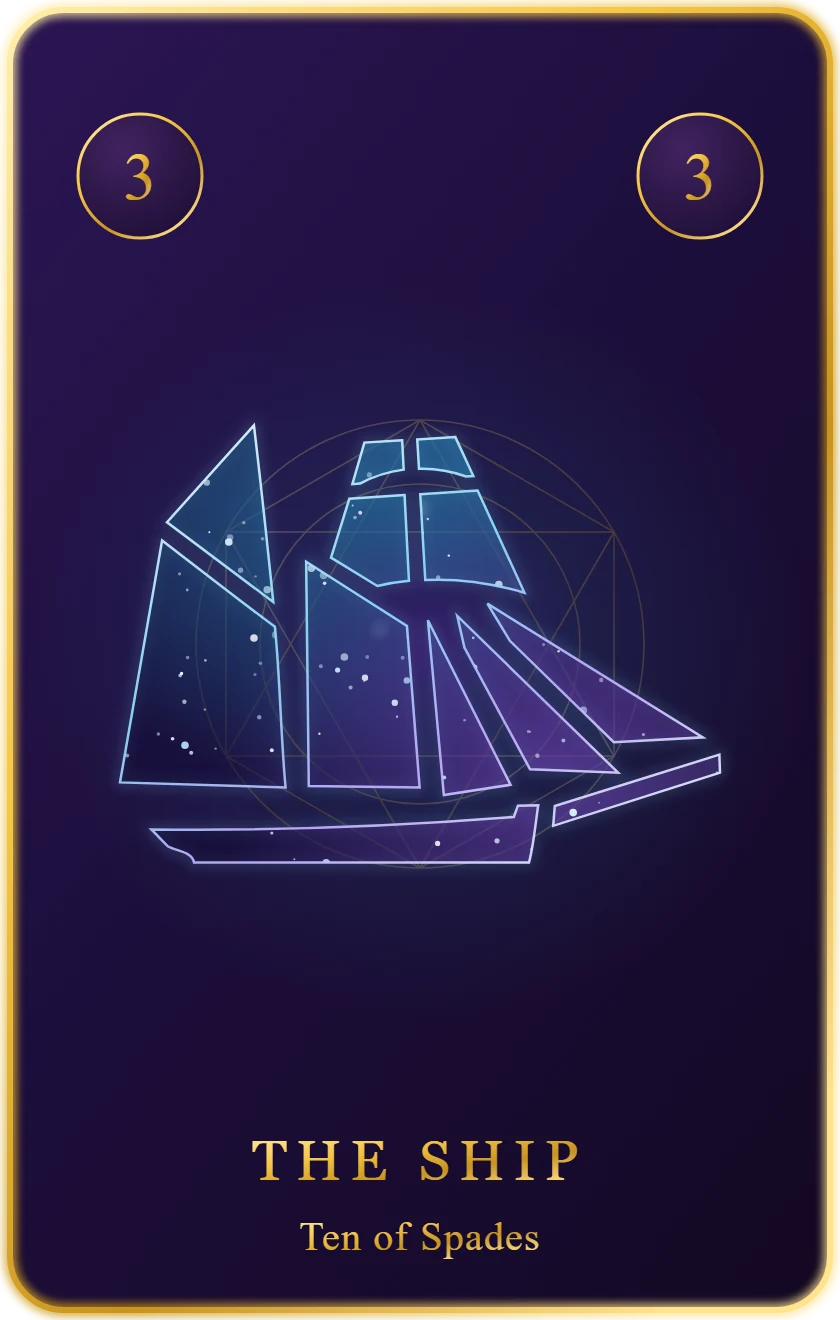
The Ship is card 3 of the Petit Lenormand, and its word is distance.
Distance already covered or distance still to cover, the direction hardly matters: the card says there is space between two points. It names departure, the crossing, remoteness, and by extension everything that comes from far away. It is a card of movement, like the Rider, but their registers differ. The Rider brings something towards you and moves fast. The Ship carries away, it puts distance in, and it takes its time.
The Lenormand stays literal: the Ship is not an invitation to an inner voyage, it is the word far placed in a sentence. A single card does not produce a reading, it produces that word. It is the neighbour that says what leaves, who leaves, or where what arrives is coming from.
On decks of the Dondorf line, around 1890, the card shows a sailing vessel on the open sea, well clear of any coast. That detail clarifies the meaning: the ship is under way, not in port. The Ship denotes the in between, the moment when one shore has been left and the other has not been reached. When it turns up on a question about waiting, it often names that intermediate state.
Three uses dominate in reading. Actual travel first: a journey, expatriation, a move when the House is nearby. Then relational distance: a bond lived from afar, a person far away, a contact kept up across space. Finally the far away as origin: what comes from abroad, an outside influence, trade that crosses borders.
A note on pace: the Ship is slow. Where the Rider signals the imminent, the Ship stretches duration out. On a question of timing, its presence leans towards the long, or towards a process that is moving without having arrived.
Playing card and traditional reading
The Ship carries the inset of the Ten of Spades. This correspondence comes from the thirty-six card piquet pack that doubled the Petit Lenormand at the outset.
In the German school, the suit of Spades introduces a share of difficulty and effort. It does not cancel the meaning of the card, it colours it: leaving implies giving something up, and remoteness has a cost. That is what distinguishes the Ship from a card of pure expansion. The movement it names calls for energy and leaves something behind.
Some modern editions do not print this inset. The correspondence still holds for the reading, it is simply absent from the artwork.
Essential combinations
Meaning is born from the pair. The grammar is fixed: the first card is the noun, the second the qualifier. The Ship followed by the House speaks of a home being moved. The House followed by the Ship speaks of a home one departs from, which is not the same thing.
| Combination | Reading |
|---|---|
| The Ship + The House | A house move, a home that shifts |
| The Ship + The Heart | A long distance relationship, an attachment that travels |
| The Ship + The Fish | Trade, money in circulation, imports |
| The Ship + The Crossroads | A possible departure with several destinations |
| The Ship + The Anchor | The voyage finds its port, the departure steadies |
To go further into the mechanics of pairs, see reading by combinations.
Position in the Grand Tableau
Position 3 of a Grand Tableau is the house of the Ship: what one sets out towards, the wish to leave, what calls from a distance.
The card that lands there indicates the nature of that elsewhere. The Fox in the house of the Ship points to a work related departure, the Heart to an emotional distance, the Mountain to a departure plan that runs into an obstacle.
The table of the thirty-six houses and the three tableau formats are set out on the Grand Tableau page.
Keywords
| Register | Words |
|---|---|
| Core meaning | Movement towards the far away and what comes from afar |
| Travel | Departure, journey, crossing, house move, expatriation |
| Distance | Remoteness, long distance bond, abroad, elsewhere |
| Pace | Slow, drawn out, under way |