Meaning
The Lily carries a simple word: maturity. Not maturity as a moral quality to be won, but the plain fact of something that has lasted long enough to settle. Card 30 of the Petit Lenormand does not say a situation is good, it says it has moved past the stage of agitation.
The Lenormand is literal: a card is not a figure to meditate on, it is a word in a sentence. The word of the Lily is “ripe”. It applies just as well to a bond as to a project, to a state of health as to a person.
Two readings sit side by side, and the context of the question decides between them. The first describes a state: serenity, calm, quiet that holds without having to be maintained. The second designates someone: a figure of experience, a person of mature years, often male in the German tradition, which the playing card correspondence confirms.
On decks of the Dondorf line, around 1890, the card shows white lilies, a flower slow to open and slow to fade. The image states the tempo better than the word does: nothing here is in a hurry.
It is therefore a card of tempo as much as of content. On a question of timing, the Lily leans towards the long term, never towards the imminent. Where the Rider hurries, it stretches things out.
One nuance needs stating, otherwise the card becomes too sweet. What is ripe no longer moves much. The Lily can name a situation that is settled because it has been resolved, but also a situation that no longer moves because everything is already in place. The difference cannot be read on the card alone, it is read on its neighbour.
That is the general rule of the deck, and it holds here more than elsewhere: a single card gives a word, not a reading. The Lily on its own says neither whether that maturity was chosen nor whether it is comfortable.
Playing card and traditional reading
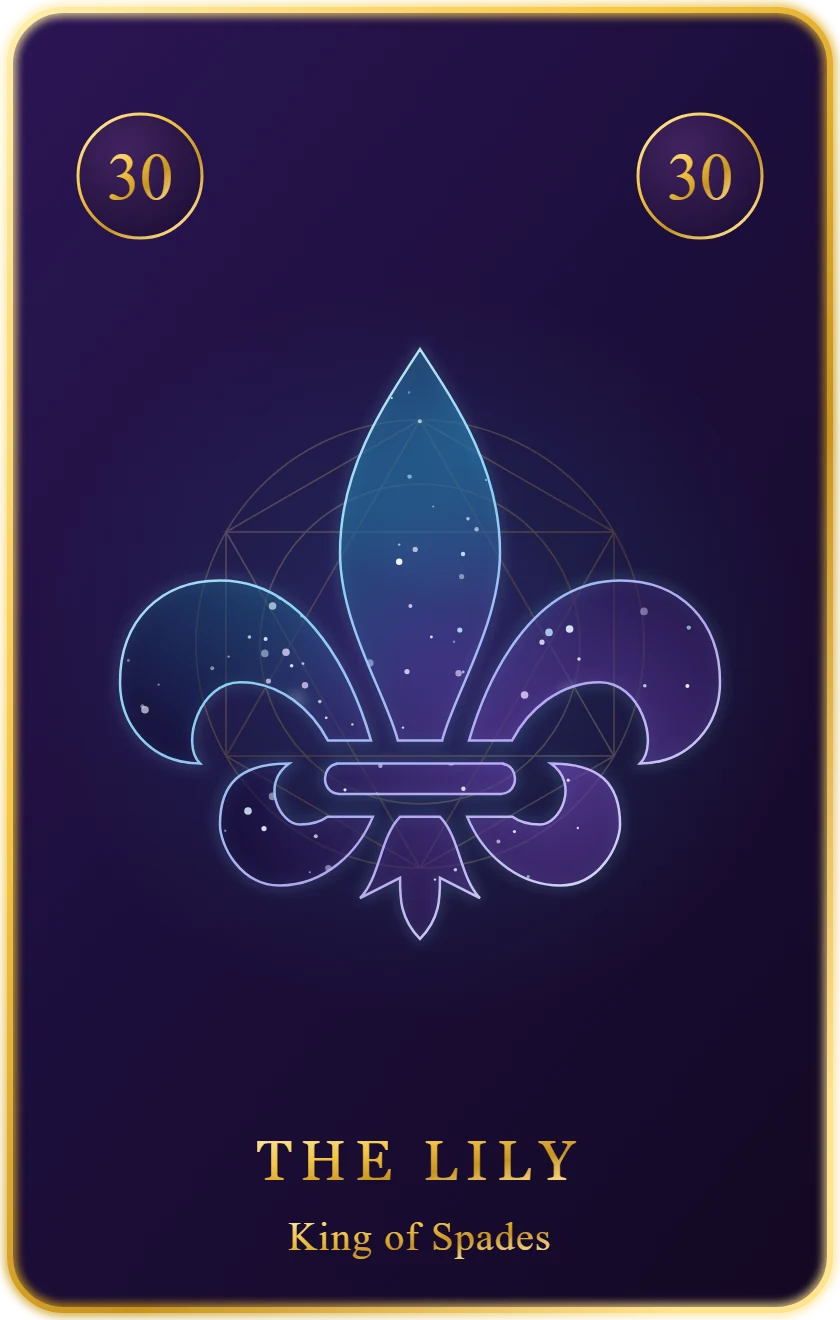
The Lily carries the inset of the King of Spades. This correspondence comes from the thirty-six card piquet deck that originally doubled the Petit Lenormand. It is fixed by the canonical table of the module, never deduced from the name of the card.
In the German school, the Spades suit brings seriousness and weight: what has density, what is not settled in a day. It does not make the Lily negative, it makes it grave. The rank of King adds the figure, an established person whose position is no longer up for discussion.
Some modern editions no longer print this inset and replace it with a verse or with nothing at all. The correspondence remains valid for the reading, it is simply absent from the artwork.
Key combinations
The grammar of the Lenormand is fixed: the first card is the noun, the second the qualifier. The Lily followed by the House designates a household that has reached maturity, the House followed by the Lily designates a maturity that concerns the family. The two pairs do not say the same thing.
| Combination | Reading |
|---|---|
| The Lily + The Heart | A mature love, a settled feeling |
| The Lily + The House | A serene home, an established family |
| The Lily + The Tree | Stable health, quiet vitality |
| The Lily + The Man | A man of mature years, a father figure |
| The Lily + The Anchor | A lasting serenity, an established peace |
The full mechanics of pairs are set out on the page about reading by combinations.
Position in the Grand Tableau
In a Grand Tableau, each place carries the meaning of the card whose number it holds. Position 30 is the house of the Lily: maturity, what settles down.
The card that lands there indicates what, in the situation, has reached its calm conclusion, or what needs time before it stabilises. The Anchor in the house of the Lily reinforces the idea of duration, the Mice qualify it: something ripe is slowly wearing down.
The table of the thirty-six houses and the three tableau formats are set out on the page about the Grand Tableau.
Keywords
| Register | Words |
|---|---|
| Core meaning | What has taken the time to ripen |
| State | Maturity, serenity, calm, established peace |
| Person | Elder figure, experience, acquired wisdom |
| Rhythm | Long term, slow, stable, without urgency |