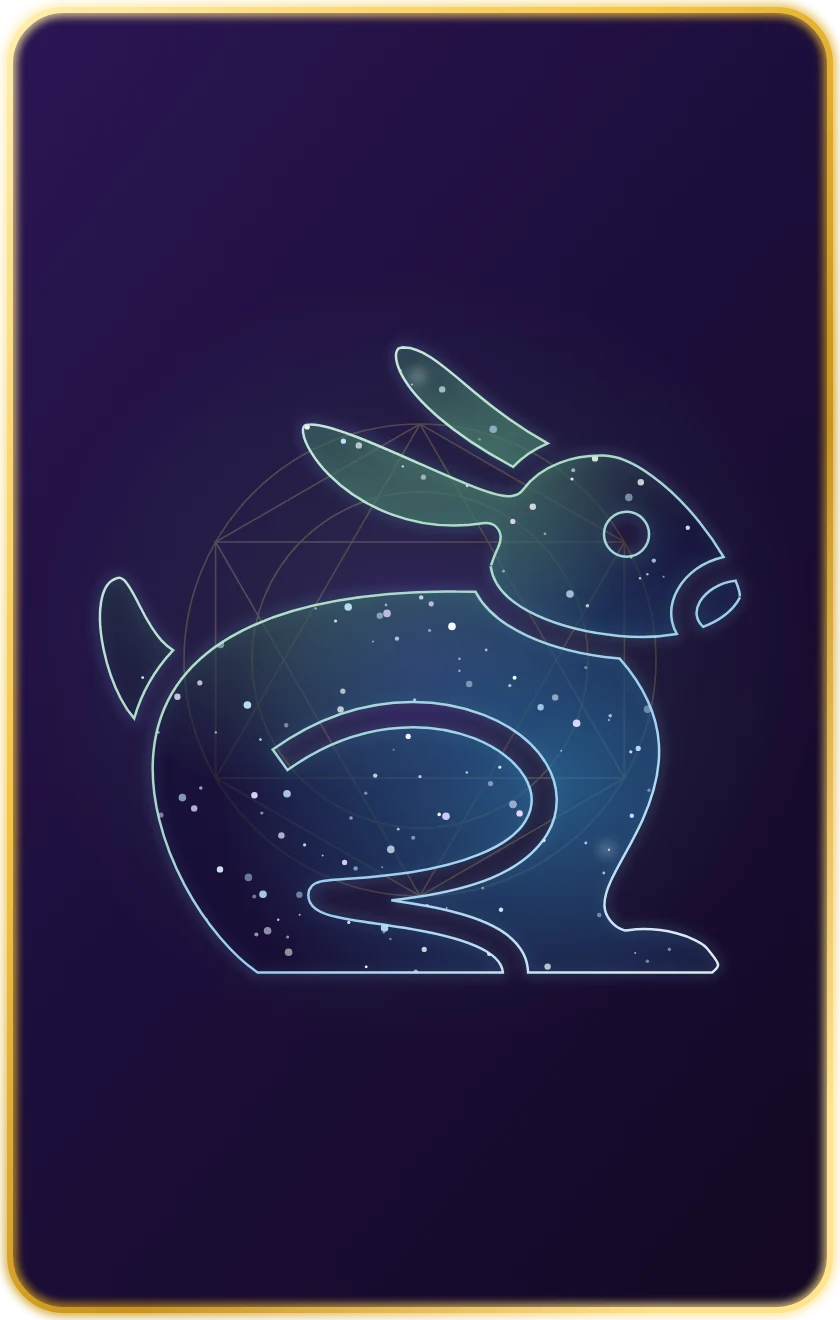
Meaning
The Rabbit is the fourth branch of the cycle of twelve, the one Chinese charts write as Mao. What it describes fits in one sentence: the finesse that obtains through agreement rather than through force. Where other temperaments advance by pushing, the Rabbit advances by adjusting. It spots what can give way, what can be gone around, what can be obtained by asking at the right moment, and it takes that road without ever thinking itself weak for doing so. This economy of means is its signature.
From there come the diplomacy and the gentleness ascribed to it. The Rabbit knows whom to speak to, in what order and with which words. It defuses more than it cuts. Its caution is not fear: it is a calculation of exposure, the preference given to the sure outcome over the spectacular one. Add to that taste, in the full sense of the word. Form matters to it as much as substance: a well kept place, a well turned sentence, a well presented proposal have a real effect on it, and it works better within what has been cared for.
The downside has a name, and it is avoidance. What the Rabbit does not want to bruise, it sets aside, postpones, covers over with courtesy. A disagreement pushed back does not disappear: it waits, and it returns heavier. The question put to this temperament is always the same, what has not been said will eventually have to be said.
This portrait describes a tendency, not a person. In a BaZi chart the animal of the year is only one character out of the eight the chart contains, and the other seven can support it as easily as contradict it.
The branch and its element
Mao is Wood, in its Yin phase. Wood is the energy that grows and seeks the light; its Yin phase gives the supple version of it, not the massive push but the stem that bends without breaking.
Mao hides only one heavenly stem, Yi, also Wood Yin. Along with the Rat and the Rooster, it is one of the three branches out of twelve in that situation. Where others shelter two or three sometimes contradictory influences, Mao says one thing and says it fully: nothing foreign comes to qualify what it announces, which makes it legible and hardly devious.
Its place in the year confirms that reading. Mao opens the 2nd BaZi month, in March, after the solar term Jingzhe, in full spring, and it looks East. Its double hour runs from 5am to 7am, the moment when the day rises without yet warming. Unmixed Wood, full spring, East: the three markers answer one another.
Alliances and clashes
Three branch relations concern Mao, and there are no others.
Its Liu He combination ties it to Xu, the branch of the Dog, and that meeting produces Fire. Two temperaments that nothing brought together give off a heat between them that neither carried alone.
Its Liu Chong opposition sets it against You, the branch of the Rooster: Wood against Metal, suppleness against the clean cut. The Rooster cuts where the Rabbit rounds off. The axis is blunt, and it forces each of the two out of its habitual fold.
Its San He trine gathers Hai, the branch of the Pig, Mao and Wei, the branch of the Goat. That trine produces Wood, that is to say the very element of Mao, which sits at its middle.
These three relations are read between the branches of one chart, or between a chart and the period it is going through. They say nothing about the agreement between two people reduced to their year of birth, a shortcut that remains the most widespread misreading of Chinese astrology.
Key facts
| Item | Value |
|---|---|
| Rank | 4th branch of the twelve |
| Branch | Mao |
| Element | Wood |
| Polarity | Yin |
| Hidden stem | Yi (Wood Yin) |
| Double hour | 5am - 7am |
| BaZi month | 2nd month (March, after Jingzhe) |
| Season | Spring |
| Direction | East |
| Liu He combination | Xu, the Dog (produces Fire) |
| Liu Chong opposition | You, the Rooster |
| San He trine | Hai, Mao, Wei (produces Wood) |
The nine years of the Rabbit closest to us, with the heavenly stem that opens each one. All carry a Yin stem, like the branch itself.
| Year | Heavenly stem | Element of the stem |
|---|---|---|
| 1939 | Ji | Earth Yin |
| 1951 | Xin | Metal Yin |
| 1963 | Gui | Water Yin |
| 1975 | Yi | Wood Yin |
| 1987 | Ding | Fire Yin |
| 1999 | Ji | Earth Yin |
| 2011 | Xin | Metal Yin |
| 2023 | Gui | Water Yin |
| 2035 | Yi | Wood Yin |
Keywords
- diplomacy
- gentleness
- caution
- taste
- avoidance